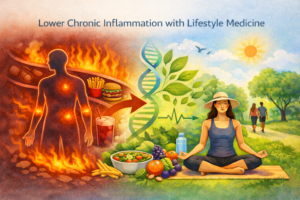
The release of new Dietary Guidelines always sparks strong reactions. Some people feel validated. Others feel frustrated or skeptical. As a Lifestyle Medicine practitioner and Diplomate of the American College of Lifestyle Medicine, I believe it’s important to slow down and look at what these guidelines actually say—where they align with evidence-based care, and where context really matters.
The American College of Lifestyle Medicine (ACLM) recently released a statement supporting several key elements of the new Dietary Guidelines, particularly their emphasis on whole foods and chronic disease prevention. I agree with much of ACLM’s position—and I also think it’s essential that people understand how dietary guidelines are created and where their limitations lie.
Both things can be true at the same time.
Where ACLM Strongly Agrees With the New Guidelines
ACLM applauds the Dietary Guidelines’ focus on food as a driver of chronic disease—and this is an area where the science is very clear.
The strongest points of alignment include:
- Emphasizing whole and minimally processed foods
- Increasing intake of fruits and vegetables
- Limiting added sugars, refined grains, highly processed foods, and sugary drinks
These recommendations reflect decades of research showing that dietary patterns rich in whole plant foods are associated with lower risk of heart disease, diabetes, obesity, and many inflammatory conditions.
This is foundational Lifestyle Medicine—and it’s an area where we should be unified.
The Core of ACLM’s Nutrition Position
ACLM’s position goes a step further by clearly outlining what an optimal dietary pattern looks like for the prevention, treatment, and even reversal of lifestyle-related chronic disease.
According to ACLM, two evidence-based principles matter most:
- A foundation of whole, minimally processed plant foods
This includes vegetables, fruits, whole grains, legumes, mushrooms, nuts, and seeds—eaten in a way that supports appropriate energy intake. - Minimizing foods that drive disease risk
This includes red and processed meats, foods high in saturated fat, and ultra-processed foods containing added sugars, refined carbohydrates, unhealthy fats, and excess sodium.
This approach isn’t about dietary perfection. It’s about reducing the foods most strongly associated with inflammation, insulin resistance, cardiovascular disease, and metabolic dysfunction.
Where Context Is Often Missing: How Dietary Guidelines Are Formed
Here’s where nuance matters.
Dietary Guidelines are not written in a vacuum of pure science. They are influenced by:
- Agricultural policy
- Industry interests
- Political feasibility
- Cultural norms
- Population-level compromise
That doesn’t make them useless—but it does mean they are highly biased toward what is achievable at scale, not necessarily what is therapeutically optimal for every individual.
Lifestyle Medicine practitioners understand this distinction. Population guidelines are a starting point—not the endpoint—for individualized care.
Saturated Fat: Not a Moral Issue, but a Clinical One
One of the most debated areas in the guidelines is saturated fat.
ACLM’s stance is not “zero saturated fat” and it’s not fear-based. It’s grounded in outcome data showing that diets higher in saturated fat—particularly from processed and animal-based sources—are associated with higher cardiovascular risk when they displace fiber-rich, plant-based foods.
What matters clinically is:
- Source of saturated fat
- Overall dietary pattern
- What it replaces in the diet
Replacing saturated fat with refined carbohydrates does not improve health. Replacing it with whole plant foods consistently does.
This is where reductionist nutrition debates miss the point. Lifestyle Medicine looks at patterns, not single nutrients in isolation.
Food as Medicine Exists on a Spectrum
One of the most important ACLM statements—and one I strongly support—is that food-based interventions exist on a continuum.
Nutrition for:
- Health promotion
- Disease prevention
- Disease treatment
- Disease reversal
…does not look the same for everyone.
Some people may benefit from modest changes. Others need more intensive, therapeutic nutrition approaches. This is where trained clinicians, not social media trends, should guide care.
Why This Matters for Patients—and Practitioners
When nutrition guidance becomes polarized, people either:
- Tune it out entirely, or
- Swing toward extremes
Lifestyle Medicine offers a grounded middle path:
- Evidence-based
- Root-cause focused
- Compassionate and practical
- Adaptable to real human lives
The ACLM’s support of whole-food, plant-predominant eating is not about ideology—it’s about outcomes. And its acknowledgment of food as a powerful medical intervention is long overdue in mainstream healthcare.
My Takeaway
I stand behind most of ACLM’s stance on the new Dietary Guidelines. I also believe patients deserve transparency about where guidelines come from—and clinicians deserve the freedom to go deeper when evidence supports it.
Nutrition doesn’t need to be extreme to be effective.
But it does need to be intentional.
This is the heart of Lifestyle Medicine—and it’s why I continue to teach, practice, and advocate for it.